
Overnight Ham Egg Breakfast Casserole turns a little evening prep into a warm, filling breakfast. Bread soaks up a simple egg custard while ham and cheddar bring plenty of savory flavor. The center bakes up soft and tender, with a golden cheese top. Assemble it before bed, then bake it the next morning.

Why I Love This Recipe
A make-ahead breakfast should give you less to do in the morning. This casserole does just that, using cooked ham and everyday ingredients without a separate stovetop step.
- Prep ahead: The bread softens in the custard while the dish chills.
- Use leftovers: Day-old bread and cooked ham fit right in.
- Easy to portion: A short rest helps the baked casserole hold together.
- Simple flavor: Cheddar and a little mustard give the eggs a savory lift.

What You’ll Need
- Servings: 8
- Prep Time: 20 minutes
- Chill Time: 8 hours, or up to 12 hours
- Cook Time: 55–65 minutes
- Rest Time: 10 minutes
- Total Time: 9 hours 25 minutes–9 hours 35 minutes, using the minimum chill time
- Oven Temperature: 350°F (175°C)
- Pan Size: 9×13-inch baking dish, about 3 quarts; use oven-safe glass approved by its maker for this use
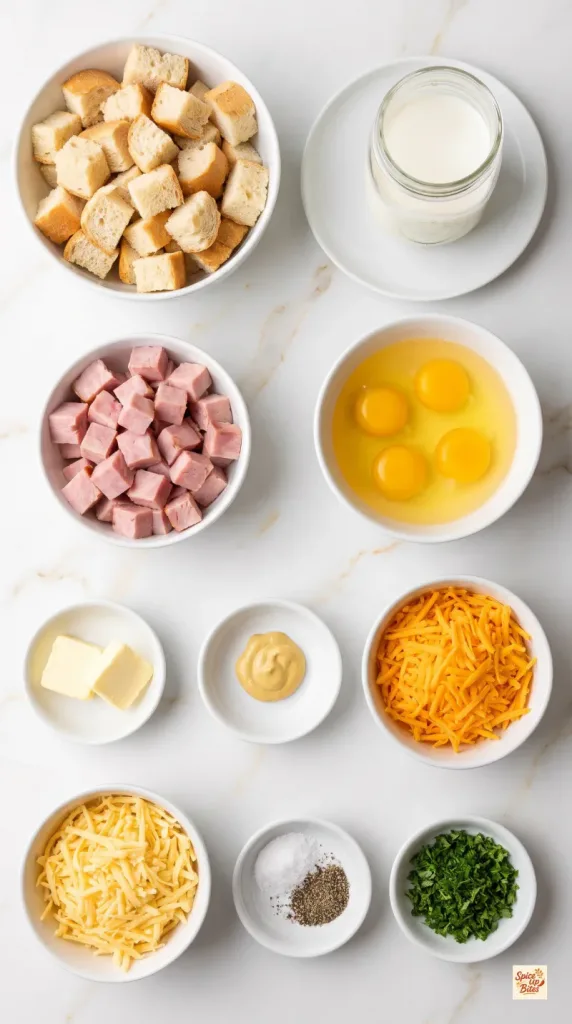
Ingredients
- 1 tablespoon unsalted butter, softened, for the dish
- 6 cups (300 g) day-old French bread, cut into roughly 1-inch cubes
- 2 cups (300 g) fully cooked ham, cut into small cubes and patted dry
- 8 large eggs
- 2 1/2 cups (600 ml) whole milk
- 2 teaspoons Dijon mustard
- 1/4 teaspoon salt
- 1/2 teaspoon ground black pepper
- 2 cups (8 oz/225 g) freshly shredded sharp cheddar cheese, divided
- 1 tablespoon finely chopped fresh parsley
Use sturdy bread with a dry feel rather than fresh, very soft sandwich bread. Leave a thin crust on; trim off any hard, thick crust that would be tough to eat. The ham and cheese already bring salt, so the added amount stays small.
Tools You Need
- 9×13-inch oven-safe baking dish
- Large mixing bowl
- Whisk and flexible spatula
- Measuring cups and spoons
- Box grater
- Foil or a fitted refrigerator cover
- Instant-read food thermometer
- Wide serving spatula
How to Make Overnight Ham Egg Breakfast Casserole
Put the casserole together the night before you plan to serve it.
Step 1: Prepare the Dish and Bread
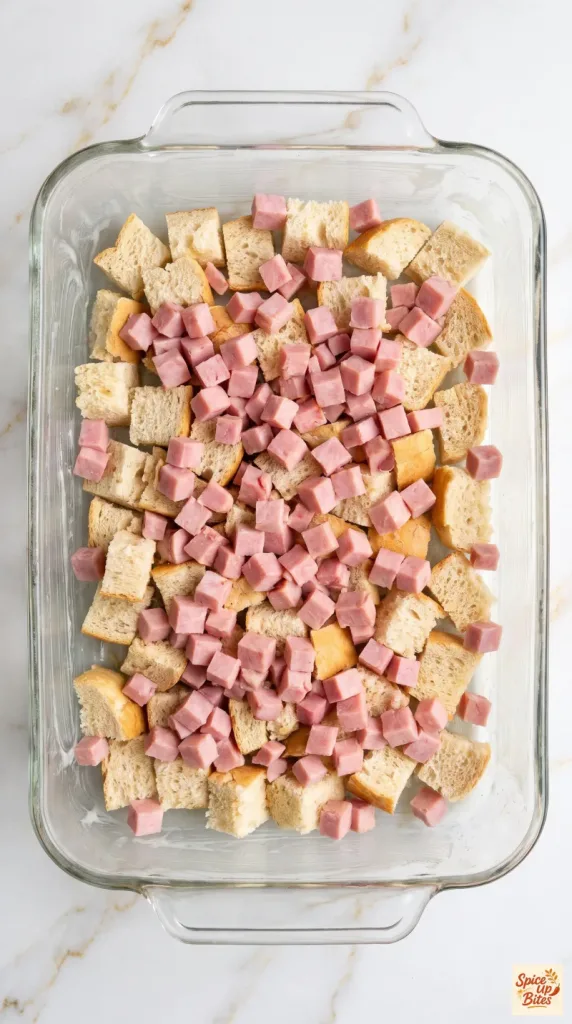
Grease the bottom and sides of a 9×13-inch baking dish with 1 tablespoon softened unsalted butter.
Spread 6 cups (300 g) day-old French bread cubes in the dish, then scatter 2 cups (300 g) fully cooked cubed ham evenly over them.
Step 2: Whisk the Custard
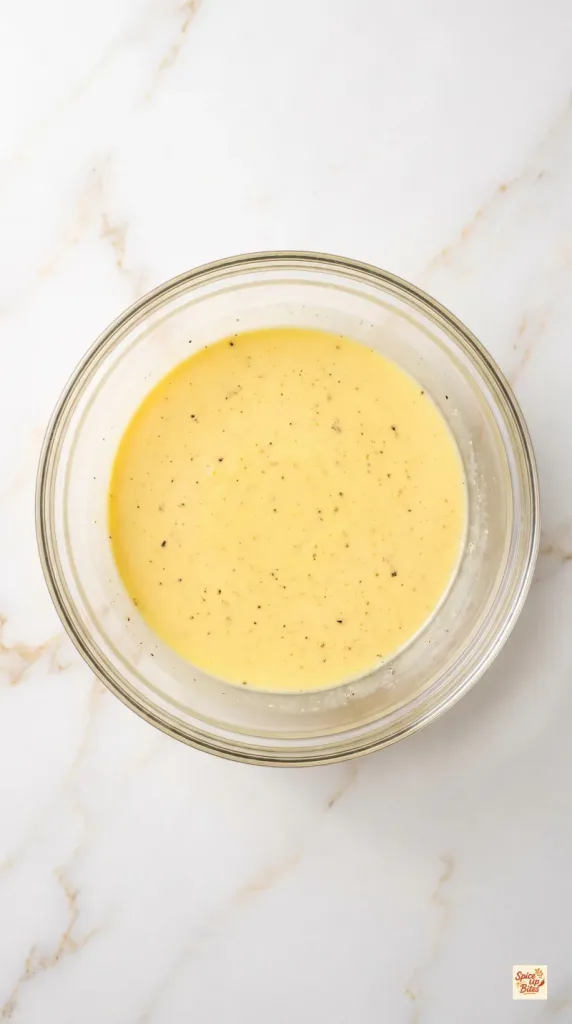
Whisk 8 large eggs in a large bowl until the whites and yolks blend together.
Add 2 1/2 cups whole milk, 2 teaspoons Dijon mustard, 1/4 teaspoon salt and 1/2 teaspoon ground black pepper. Whisk until smooth.
Step 3: Assemble and Chill
Pour the custard evenly over the bread and ham, then fold in 1 cup (4 oz) shredded cheddar with a flexible spatula so the bread is coated throughout.
Press the bread gently into the liquid. Spread the remaining 1 cup (4 oz) shredded cheddar in a thin, even layer over the top.
Cover the dish and refrigerate at 40°F (4°C) or below for 8–12 hours. Keep it chilled until you are ready to bake.

Step 4: Bake Until Set
Heat the oven to 350°F (175°C). Follow your baking dish maker’s instructions for moving refrigerated glass into a heated oven; never use a damaged dish or set hot glass on a cold or wet surface.
Remove the refrigerator cover and cover the dish loosely with foil. Bake on the middle rack for 30 minutes.
Remove the foil and bake for another 25–35 minutes, until the top is golden and the center is set. A thermometer inserted into the center must reach 160°F (71°C); there should be no liquid egg when you gently separate the center with a spatula.
If the top browns before the middle sets, cover loosely with foil again and keep baking. Sprinkle 1 tablespoon finely chopped fresh parsley over the melted cheese as soon as the casserole comes out of the oven.

Step 5: Rest and Serve
Let the casserole rest for 10 minutes, then cut it into 8 portions and lift them out with a wide spatula.
Serve warm on its own, or offer strawberries, red grapes, blackberries, fresh figs and plain yogurt on the side for a fuller breakfast. Keep the fruit and yogurt beside the casserole rather than over the cheese.

Why This Recipe Works (Quick Science)
Bread absorbs the milk and egg mixture during the overnight rest. That lets the custard reach the center of the cubes, so the bake has a tender middle instead of dry pockets.
As the eggs heat, their proteins form a soft network that holds the soaked bread and ham together. Milk keeps that network tender. Baking too long tightens it and can squeeze out moisture, so check the center rather than waiting for very dark edges.
Cheddar inside the casserole adds flavor throughout, while the top layer melts into a light crust. Resting gives the custard a chance to settle before you cut it.

Common Mistakes to Avoid
- Packing the bread into the cup: Measure loosely and use the weight when possible. Too much bread makes a dry casserole.
- Using wet ham: Pat it dry so excess water does not thin the custard.
- Skipping the soak: Dry bread needs time to absorb the liquid evenly.
- Judging by the cheese alone: A golden top does not mean the egg in the middle is cooked.
- Cutting too soon: The short rest makes each portion easier to lift.
Pro Tips
Grate cheddar from a block for a smoother melt. Spread the ham all the way to the edges so the corners have as much flavor as the middle.
If your bread is fresh, spread the cubes on a baking sheet and dry them at 300°F (150°C) for 15–20 minutes, turning once. Let them cool before measuring and assembling. This adds to the listed prep time.
Substitutions and Variations
- Bread: Use the same weight of sturdy country bread or mild sourdough. Different loaves absorb liquid at different rates.
- Cheese: Replace half the cheddar with Swiss for a milder, nutty flavor.
- Milk: Whole milk gives the richest result without cream. Two-percent milk also works, with a slightly lighter texture.
- Extra vegetables: Fold in up to 1/2 cup cooked, cooled, well-drained peppers or spinach with the bread. Avoid adding raw watery vegetables.
What to Serve With Overnight Ham Egg Breakfast Casserole
The casserole already has eggs, meat, bread and cheese, so light sides work well. Strawberries, red grapes, blackberries and fresh figs add a fresh contrast. Plain yogurt can go in a small bowl alongside the fruit.
These sides are optional and are not included in the casserole’s nutrition estimate. For breakfast for dinner, a simple green salad is another easy choice.
Leftovers and Storage
Refrigerate leftovers in a shallow covered container within 2 hours of baking. Store at 40°F (4°C) or below for 3–4 days.
Reheat individual portions, loosely covered, in the microwave in 30-second bursts until the center reaches 165°F (74°C). Or cover portions with foil and warm in a 325°F (165°C) oven until hot throughout.
For longer storage, wrap cooled portions well and freeze for up to 2 months for best quality. Thaw in the refrigerator overnight before reheating. Freeze the baked casserole rather than the raw, soaked mixture for a more predictable texture.
Macros Information
Estimated per serving, based on 8 portions, without optional sides. Brands and bread type will change these values.
- Calories: 400 kcal
- Protein: 27 g
- Carbohydrates: 27 g
- Fat: 20 g
- Saturated Fat: 10 g
- Fiber: 1 g
- Sugar: 6 g
- Sodium: 1,000 mg
Frequently Asked Questions (FAQ)
Q: Can I use leftover holiday ham?
A: Yes. Use fully cooked ham that has been stored safely. Trim tough edges, remove any bone and pat the cubes dry. Avoid pieces with a thick, sweet glaze if you want a purely savory breakfast.
Q: Does the bread need to be stale?
A: Day-old bread works well because it holds its shape while it absorbs the custard. Fresh bread can be dried in the oven first, then cooled.
Q: Can I leave out the bread?
A: This recipe relies on bread to absorb the milk. Leaving it out would require a different egg-to-milk ratio, so use a bread-free egg bake recipe instead.
Q: Can I assemble it more than one night ahead?
A: For this version, stick to the stated 8–12 hours. A longer soak may soften the bread more than you want.
Q: Why is the middle still wet?
A: It may need more baking time, especially if the dish started very cold. Cover the top loosely if needed and keep baking until the center is set and reaches 160°F (71°C).
Q: Why did my casserole sink a little?
A: Some settling is normal as the hot egg mixture cools. A large collapse with liquid in the middle usually means the center needed more time.
Q: Can I halve the recipe?
A: Yes. Halve every ingredient and use an 8-inch square baking dish. Start checking after 35 minutes, but rely on the set center and 160°F (71°C) temperature rather than the clock alone.
Q: Can I use pre-shredded cheese?
A: Yes. It is convenient, though freshly grated cheddar usually melts more smoothly. Use the same total weight and divide it as directed.
Q: Can I bake it in a metal pan?
A: Yes, use a 9×13-inch metal baking pan. Metal may brown the edges sooner, so check early and use the same center temperature to judge doneness.
Final Thoughts
Overnight Ham Egg Breakfast Casserole makes a cozy breakfast with a little planning and very little morning prep. Let the bread soak, bake until the center is set and give it a short rest before serving. Leave a comment with your favorite way to use leftover ham. Happy cooking!
1 thought on “Overnight Ham & Egg Breakfast Casserole”
Comments are closed.